

What’s in This Article
The Taiwan Indictment
Table 1: Restricted B300 AI Server Diversion Alleged by Taiwanese Prosecutors
Why Paper-Based Export Controls Failed
What I Proposed in July 2025
Table 2: Hardware-Enforced Controls for Export-Restricted AI Systems
The Difference Between Attestation and Surveillance
Remote Access Creates a Second Export-Control Loophole
The Investment Implications for Nvidia and Supermicro
Investor Takeaway
The Taiwan Indictment
Thirteen months ago, I argued that Nvidia’s export-controlled artificial intelligence chips would eventually require a hardware-enforced “kill switch” because licenses, end-user certificates, shipping manifests, customs inspections, and corporate compliance programs would never be sufficient to keep the most advanced American AI hardware out of restricted Chinese hands.
On August 24, 2026, that argument stopped being a theoretical exercise.
Taiwanese prosecutors indicted nine people, reportedly including a senior Nvidia (NASDAQ: NVDA) manager and two employees of Super Micro Computer (NASDAQ: SMCI), on charges involving breach of trust and document forgery. Prosecutors allege that the group falsified end-user documentation to conceal the diversion of high-end Nvidia B300 AI servers to customers in China.
The case has not produced convictions, and the accusations must therefore continue to be treated as allegations. Nevertheless, the indictment exposes a structural weakness in the current U.S. export-control system: enforcement depends primarily on documents and intermediaries surrounding the technology rather than controls engineered into the technology itself.
According to Table 1, the alleged scheme covered 130 B300 servers that were represented as being installed and operated at an approved facility in Taiwan. Taiwanese prosecutors allege that 74 servers were ultimately delivered to Chinese customers, while the remaining 56 were intercepted before reaching their intended destination.
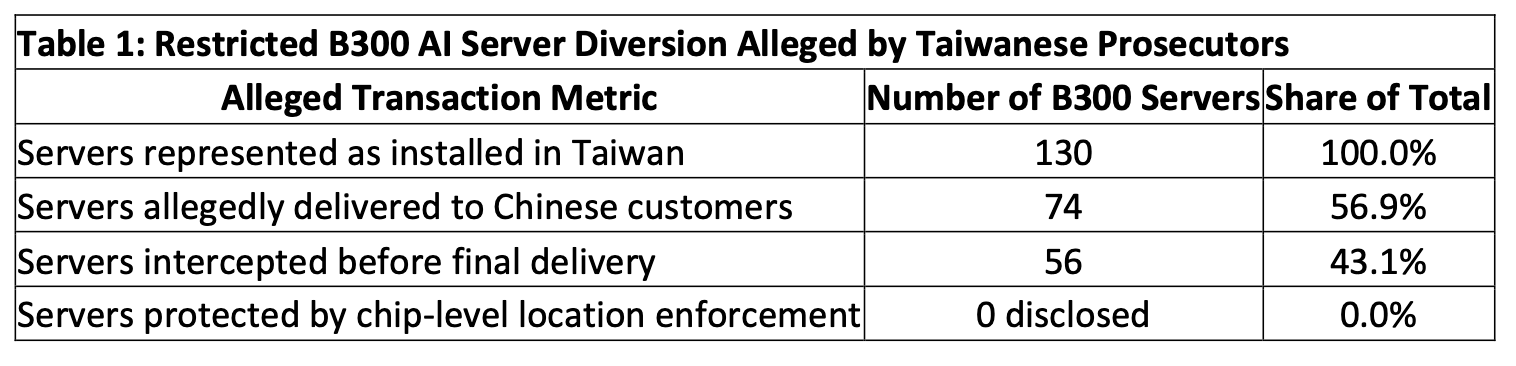
The final row is the most important. Nothing publicly disclosed indicates that the B300 systems were protected by a hardware-enforced mechanism capable of independently determining whether they had been activated in an authorized environment.
The systems were controlled through documents, corporate procedures, distributors, logistics networks, and customs enforcement. Once individuals inside those networks allegedly agreed to forge the documents, the restrictions became substantially easier to circumvent.
This was not primarily a semiconductor failure. It was an enforcement-architecture failure.
Why Paper-Based Export Controls Failed
The alleged diversion did not require Chinese engineers to reverse-engineer the B300 GPU, defeat its encryption, alter its circuitry, or manufacture a substitute device. According to prosecutors, the conspirators simply created records claiming that the servers were installed in Taiwan when many of them were being sent elsewhere.
The servers did not need to be technically disguised. Their destination was disguised.
That distinction is central to understanding the limitations of present export controls. The U.S. government can restrict the shipment of advanced AI accelerators, but it must rely on manufacturers, server assemblers, distributors, freight forwarders, customs authorities, data-center operators, and end users to truthfully document every stage of the transaction. Each intermediary creates another point at which a false statement, shell company, diverted shipment, or concealed customer can defeat the policy.
The U.S. Justice Department had already revealed the potential scale of this problem. In March 2026, federal prosecutors charged Supermicro co-founder Wally Liaw and two other individuals with allegedly conspiring to divert approximately $2.5 billion of AI servers containing controlled GPUs to China beginning in 2024.
Jensen Huang subsequently urged Supermicro to improve its compliance controls. Supermicro says it terminated employees implicated by an internal investigation, strengthened its procedures, and cooperated with authorities. Its third-party investigation reportedly found no involvement by its current senior management.
Yet the latest indictment reportedly reaches inside both companies, including an Nvidia manager and Supermicro employees. The issue is therefore broader than whether one distributor filed inaccurate paperwork. It raises the possibility that individuals with knowledge of the manufacturers’ internal controls allegedly helped customers navigate around them.
The traditional response would be to add more compliance personnel, increase audits, strengthen customer screening, and demand additional certifications. All those measures are necessary, but none changes the underlying weakness: a document remains only as reliable as the people producing and reviewing it.
What I Proposed in July 2025
In my July 18, 2025 Substack article, “How Nvidia Can Build Self-Destruct H20 AI Chips to Prevent China’s Military Use,” I argued that the technical foundations for hardware-enforced export compliance already existed.
I was not claiming that Nvidia had secretly placed a destructive mechanism inside the H20. Nvidia subsequently denied that its chips contained backdoors or remote-disabling functions. My argument was that controlled AI processors could eventually be designed to enforce authorization requirements through secure hardware, firmware, cryptographic identity, and periodic verification.
The phrase “kill switch” captured the objective, but the most commercially realistic implementation would not require a chip to physically burn itself out. A secure, reversible disabling mechanism would generally be safer and more practical. It could prevent initialization, restrict high-performance operation, disable high-speed interconnects, or revoke access to signed firmware until the system was returned to an authorized environment.
According to Table 2, no single mechanism would solve the diversion problem. Effective enforcement would require several controls operating together, beginning with a unique hardware identity and extending through secure provisioning, attestation, authorization renewal, and tamper detection.