
The Announcement Gap

What’s in This Article
Introduction
Chart 1. How Circular AI Financing Converts Support Into Supplier Demand
The Deals Behind the Headline Figures
Table 1. Major AI Transactions Involving Supplier-Enabled or Reciprocal Demand
Nvidia and OpenAI: Investment Tied to Deployment
AMD’s Warrants Convert Purchases Into Equity Value
Nvidia and CoreWeave Complete Another Loop
Oracle–OpenAI Requires a Different Classification
The BIS Warning About Financial Interdependence
Where Circular Financing Fits With Wall Street’s Capital Contradiction
Where Circular Financing Fits With the South Korea Capacity Gap
Investor Takeaway
Introduction
Two analyses I completed during the past several weeks arrived at a related conclusion: investors cannot rely on the size of an announced commitment without examining how much capital will actually be deployed, when it will become productive, and who ultimately provides the financing.
In “South Korea Promised to Double DRAM Memory Capacity. It May Deliver Less Than 10% a Year,” published July 20, I explained why the hundreds of billions of dollars committed by Samsung Electronics (SSNLF) and SK hynix (SKHY) to expand South Korean semiconductor production will not produce a comparable increase in operating DRAM capacity on the timeline the market is currently pricing. Reuters reported that South Korea hopes to double its memory-production capacity within five years. However, fab construction, cleanroom qualification, equipment installation, older-fab shutdowns, and the conversion of commodity DRAM lines to HBM mean that announced investment cannot be treated as immediately available wafer capacity. The announced investment and the capacity ultimately delivered are not the same number.
In “The Great Space Collapse and the Thundering Herd,” published August 5 in Gilder’s Technology Report, I examined how investors traded SpaceX (SPCX), Rocket Lab (RKLB), and Planet Labs (PL) as a single category despite substantial differences in their businesses, financial structures, and capital requirements. The contradiction was particularly evident at SpaceX: the company must invest heavily in Starship, Starlink, launch infrastructure, and artificial intelligence to create the growth supporting its valuation, yet the scale of that investment became a reason for investors to question its free cash flow and reduce its valuation. If SpaceX curtailed those investments, investors would probably question its growth prospects; when it maintained them, investors questioned whether the spending would generate adequate returns.
These examples reflect the same underlying problem. The number announced is not necessarily the number delivered, and Wall Street frequently evaluates capital spending according to where it appears in a financial statement rather than according to its economic purpose. Spending is bullish when it becomes a supplier’s revenue and bearish when it reduces the customer’s free cash flow. Circular financing is a more direct version of that contradiction because the supplier can provide the equity, guarantee, warrant, or purchase commitment that helps create the customer demand subsequently reported as revenue.
Circular financing does not necessarily make the resulting equipment orders fictitious. The processors, memory, networking systems, and data centers can still be delivered and used. What changes is the independence of the demand. When a supplier invests in a customer, guarantees its lease, grants it warrants tied to purchase milestones, or commits to buying the capacity built with the supplier’s own equipment, the financing and the reported demand become parts of the same economic arrangement.
According to Chart 1, circular financing converts financial support into supplier demand through several mechanisms. Nvidia (NVDA) can invest in or potentially guarantee financing for an AI customer that subsequently purchases Nvidia systems. Advanced Micro Devices (AMD) grants performance-based warrants whose vesting depends directly on OpenAI and Meta Platforms (META) reaching defined GPU-purchase milestones. Nvidia’s relationship with CoreWeave (CRWV) combines equity ownership, Nvidia GPU purchases, and Nvidia’s commitment to purchase unused cloud capacity from infrastructure built around its own processors.
These arrangements do not make the underlying demand artificial. They make it more difficult to distinguish independently financed customer demand from demand enabled or reinforced by the supplier itself.
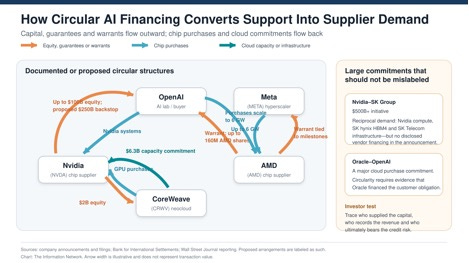
Chart 1. How Circular AI Financing Converts Support Into Supplier Demand