When Does AI Data Center Expansion Stop Making Economic Sense?

What’s in This Article
Introduction
The Economic Metric Used in This Analysis
Establishing the Capital Cost of an AI Accelerator
Table 1. Baseline Capital Cost per Accelerator (Annualized)
Accounting for Electricity as an Operating Cost
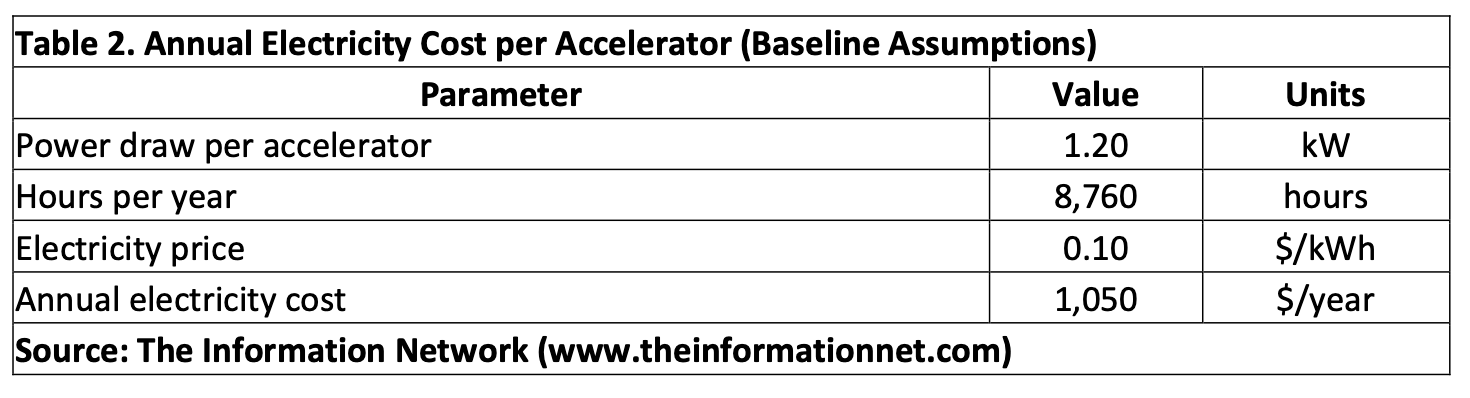
Table 2. Annual Electricity Cost per Accelerator (Baseline Assumptions)
Combining Capital and Operating Costs
Table 3. Total Annual Cost per Accelerator
Translating Annual Cost Into Productive Hours
Table 4. Productive GPU Hours per Year by Utilization Rate
Deriving Required Revenue per GPU-Hour Under Baseline Conditions
Table 5. Required Revenue per GPU-Hour Under Baseline Conditions
How Rising Costs and Falling Utilization Combine
Table 6. Scenario Inputs and Required Revenue per GPU-Hour
Investor Takeaway
Introduction
Recent reports of hyperscalers delaying selected data center projects, local governments imposing temporary restrictions on new developments, and growing concern that artificial intelligence infrastructure spending may have become excessive have revived a familiar question on Wall Street: Is the AI investment boom beginning to resemble previous technology bubbles?
The debate has intensified as investors attempt to reconcile two seemingly contradictory developments. On one hand, hyperscalers continue to commit hundreds of billions of dollars to artificial intelligence infrastructure, while demand for advanced AI models and inference capacity remains robust. On the other hand, headlines increasingly focus on construction delays, power shortages, financing challenges, and growing concerns that some projects may not generate acceptable returns on the enormous capital required to build them.
These developments have led many investors to conclude that AI demand may be weakening. That interpretation, however, may be too simplistic. Slower data center deployment does not necessarily imply weaker demand for AI computing. Instead, the industry may be entering a new phase in which the pace of expansion is determined less by customer demand than by the economics of deploying increasingly capital-intensive infrastructure.
Nvidia CEO Jensen Huang has estimated that a single gigawatt-scale AI super-factory represents approximately $50 billion of investment, including roughly $35 billion for AI processors and approximately $15 billion for supporting data center infrastructure. At this scale, financing, construction execution, power availability, and return on invested capital become just as important as demand for AI services themselves. The investment question has therefore evolved from whether organizations want more AI compute to whether each additional increment of computing capacity can generate sufficient returns to justify the capital required to build, finance, and operate it.
This article examines that question quantitatively. Rather than forecasting AI demand or cloud pricing, it builds the cost structure of a GPU-based AI data center step by step and derives the revenue required per hour of productive GPU use to break even. Although the calculations focus on individual accelerators, the same economic principles ultimately determine whether multi-billion-dollar AI infrastructure projects create value for investors or simply add capacity.
The Economic Metric Used in This Analysis
The central metric used throughout this article is Required Revenue per GPU-Hour.
Required Revenue per GPU-Hour is defined as the minimum revenue that must be generated by a single GPU for every hour it is productively used in order to recover its full annual cost. Full annual cost includes the annualized capital cost of the accelerator and its attached memory, as well as the electricity required to operate it.
This metric is not a cloud pricing rate, not a billing figure charged to customers, and not a statement about AI demand. It is an internal economic threshold implied by costs and utilization. If realized revenue per productive GPU-hour exceeds this threshold, the investment is profitable. If it does not, the investment destroys value regardless of strategic importance.
The calculation used throughout the article is the same in every case:
Required Revenue per GPU-Hour
= Total Annual Cost per Accelerator ÷ (8,760 × Utilization)
All tables below exist to make each component of that equation explicit.
Establishing the Capital Cost of an AI Accelerator
According to Table 1, the first component of annual GPU cost is capital recovery. GPUs and their attached memory are large upfront investments that must be amortized over their useful life. This cost exists regardless of utilization.
In the baseline case used here, the combined cost of the accelerator and its attached memory is assumed to be $24,000 per unit. An economic life of five years is assumed. Dividing the upfront cost by the assumed life yields an annual capital recovery cost of $4,800 per accelerator. This number represents the minimum annual revenue contribution required simply to recover the hardware investment.

Accounting for Electricity as an Operating Cost
According to Table 2, electricity represents a recurring operating cost that scales with time rather than utilization. Even if a GPU is lightly utilized, power must still be supplied whenever the system is active.
Annual electricity cost is calculated using three inputs: average power draw per accelerator, total hours in a year, and the price of electricity. The baseline assumptions used here are a power draw of 1.2 kilowatts per accelerator, 8,760 hours per year, and an electricity price of $0.10 per kilowatt-hour. Multiplying these values yields an annual electricity cost of approximately $1,050 per accelerator.
This cost adds directly to the annual economic burden that must be recovered through productive use.